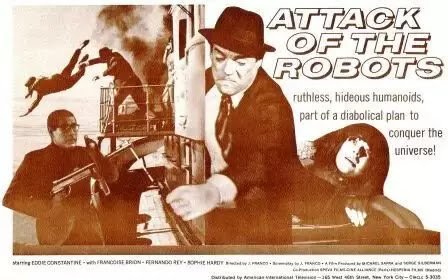
Attack of the Robots

Attack of the Robots (Cartas boca arriba)

Movie · 1966 · 10 people

Jesús Franco directed the spy film Attack of the Robots (Spanish title Cartas boca arriba, "cards face up"; in France Cartes sur table) in 1966 as a Spanish-French co-production. Running about 92 minutes, it mixes crime, comedy and science fiction. Eddie Constantine stars, with Françoise Brion, Fernando Rey and Sophie Hardy.

Constantine plays Al Pereira, a spy called back from retirement to unravel a string of murders committed by a robot-like army of people in black-framed glasses, their skin oddly darkened. The script plays on Constantine's familiar screen image by turning his hero into a clumsier agent.

Madrid-based Hesperia Film and Paris-based Cine Alliance and Spéva Films produced it, the same group that had financed The Diabolical Dr. Z. Franco joined when the project had already been sold around the world as a Constantine spy story. The screenplay is by Jean-Claude Carrière, and it was his last collaboration with Franco. Released in France and Spain in 1966, it opened ninth at the Paris box office for 27 April to 3 May. Film historians Francesco Cesari and Roberto Curti call it a good commercial success in Spain. The papers ABC and El Mundo Deportivo were generally positive; the magazines Film Ideal and Image et son were not.

DirectorJesús Franco
Production companyHesperia Film, Cine Alliance, Spéva Films

Reactions

You can pick up to 3 reactions.

Cast

Only cast members with a profile on this site are listed.
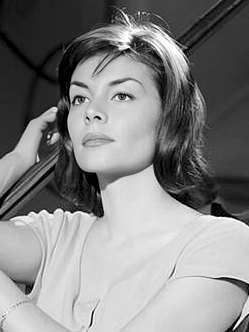
Françoise Brion Françoise Brion Actor · died at 92 Eddie Constantine Fernando Rey Sophie Hardy Alfredo Mayo Ricardo Palacios Antonio Giménez Escribano Lemmy Constantine Ramón Centenero Mara Laso
Through different eyes

Cinephile Looks at script, editing and directing choices; keeps a distance from formula films.

The film's most interesting idea is a script that inverts Eddie Constantine's familiar tough-agent image and turns him into a clumsier hero. Jean-Claude Carrière's hand shows in this playful star parody; deliberately breaking a mould the audience knows is a clever wink at the spy craze of the day. But the tone, swinging between crime, comedy and science fiction, isn't consistent in my view: parody and genre sometimes blur, and the film can't decide which one it takes seriously. No surprise that critics of the time were split. For fans of European spy films it's an odd, likeable curio; for a general audience, a footnote in film history.

Action & Thriller Fan Puts pace, tension and set pieces first; little patience for slow drama.

An agent called back from retirement, a robot-like army in black-framed glasses: the idea is genuinely fun. Just don't mistake it for an action film. The hero is written clumsy on purpose and the film leans on jokes more than tension. If you're used to today's spy films, both the pace and the suspense may feel pretty modest. Worth a stop if you're curious about the sixties spy craze.

History & Society Lens Asks about the period, the social background and what the work reflects.

The film is a good example of the spy craze that swept Europe in the mid-sixties and of how Spanish-French co-productions worked: the project had been sold around the world as a spy story on the strength of its star before its director was even on board. That shows plainly how decisive a star's image was in the cinema of the time. Today's viewers will also notice an uneasy detail: using darkened skin as a visual marker for the villains' army can carry uncomfortable associations now. Watching with that in mind helps place the film more accurately in its own time.

These are not reader reviews: they are short editorial takes written from different viewer perspectives with AI assistance. Reader reviews are below.

Reviews (0)

Log in Log in to write a review.

Comments