Under Ten Flags

Under Ten Flags

Movie · 1960 · 15 people

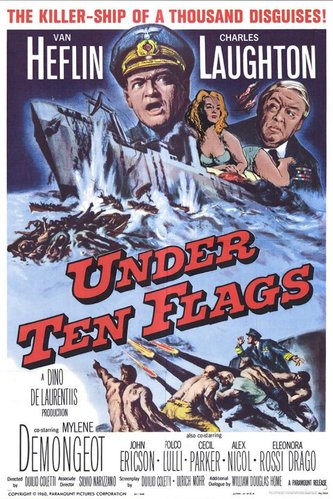
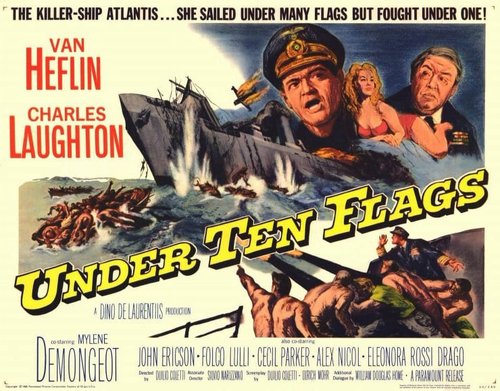
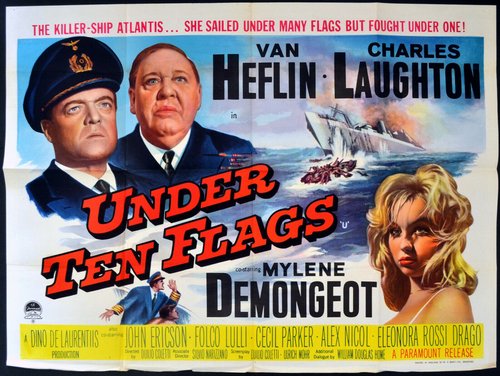
Dino De Laurentiis Cinematografica produced Under Ten Flags (Italian: Sotto dieci bandiere), a 1960 English-language Italian-American war drama distributed by Paramount. Duilio Coletti directed it, and Carlo Lizzani is also credited as a director in some listings. Van Heflin, Charles Laughton and Mylène Demongeot lead the cast, and it is one of Laughton's last films. It was selected for the 10th Berlin International Film Festival, where it premiered in June 1960.

The film deals with the 622-day raiding voyage of the German auxiliary cruiser Atlantis in the Second World War. Its title comes from the ship's false-flag tactic, approaching Allied merchant vessels under many different national flags. The narrative covers events of 1940-1941 and carries through to the ship's sinking in 1941. The cast also includes Folco Lulli, Gian Maria Volonté, Umberto Spadaro, Geronimo Meynier, Corrado Pani, Dieter Eppler, Moira Orfei, Guido Celano and Alex Nicol. It runs about 92 minutes.

The screenplay is loosely based on the memoirs of the ship's commander, Bernhard Rogge, first published in 1955; by 1960 Rogge was a rear admiral in the West German navy. The script is credited to Coletti and Rogge.

DirectorDuilio Coletti
Production companyDino De Laurentiis Cinematografica
Under Ten Flags Under Ten Flags Under Ten Flags

Reactions

You can pick up to 3 reactions.

Cast

Only cast members with a profile on this site are listed.

Alex Nicol Alex Nicol Actor · died at 85 Guido Celano Guido Celano Actor · died at 83 Van Heflin Charles Laughton Folco Lulli Mylène Demongeot Gian Maria Volontè Umberto Spadaro Geronimo Meynier Corrado Pani John Ericson Dieter Eppler Moira Orfei Cecil Parker Edith Peters

Through different eyes

Action & Thriller Fan Puts pace, tension and set pieces first; little patience for slow drama.

A raider cruiser creeping up on enemy merchant ships under false flags: on paper, a great suspense idea. The question of whether they will be spotted on each approach is a perfect engine for the story. But squeezing a voyage of nearly two years into one film risks turning events into a string of summaries. An intriguing subject for naval-war fans, though the pace may come in waves.

Cinephile Looks at script, editing and directing choices; keeps a distance from formula films.

That the screenplay rests on the memoirs of the ship's actual commander, Bernhard Rogge, and is credited to him as well, is both the film's strength and its weakness. It lends the voyage an insider's sense of detail, but it also raises the question of how much critical distance the film can keep from the commander. A hero is hard to question in a story adapted from his own memoirs, so the drama is likely to shift from people to strategy. That some listings also credit Carlo Lizzani as director suggests this is best seen as a studio co-production rather than the work of a single artistic signature. Being one of Charles Laughton's last films makes it interesting for film history too.

History & Society Lens Asks about the period, the social background and what the work reflects.

That an Italian-American production centred on the voyage of a German auxiliary cruiser was made only fifteen years after the war is itself a sign of the times. Rogge, credited on the script, was by then a rear admiral in the West German navy, which recalls a period when former enemies were finding new places in the post-war order. It is no surprise, then, that a story based on the commander's memoirs gives its weight to the raider's point of view rather than to the merchant ships it attacks. Reading the film in that context makes it easier to see both what it tells and what it leaves out.

These are not reader reviews: they are short editorial takes written from different viewer perspectives with AI assistance. Reader reviews are below.

Reviews (0)

Log in Log in to write a review.

Comments