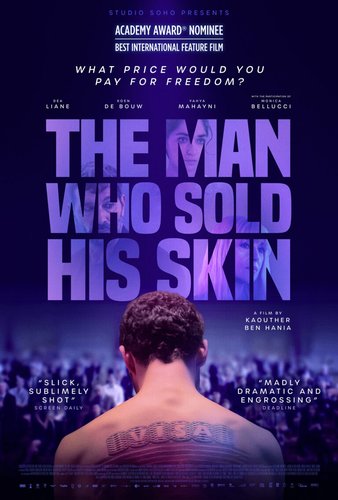
The Man Who Sold His Skin

The Man Who Sold His Skin (L'Homme qui a vendu sa peau)

Movie · 2020 · 4 people

Kaouther Ben Hania wrote and directed The Man Who Sold His Skin, a drama from 2020. A France-Tunisia-Germany co-production, it moves between sharp satire and dark comedy. Spoken in Arabic, English, French and Flemish, it premiered at Venice in September 2020. In March 2021 it was nominated for the Oscar for Best International Feature Film, making it the first Tunisian film to compete in that category.

At its centre is Sam Ali, a sensitive, impulsive Syrian played by Yahya Mahayni. He has fled the civil war for Lebanon and longs to reach Europe, where Abeer (Dea Liane), the love of his life, now lives. To get there, he hands his back to a contemporary artist: a Schengen visa is tattooed on it, and his body becomes a prestigious artwork on display. He soon discovers that the deal restricts his freedom instead of expanding it. Koen De Bouw and Monica Bellucci co-star.

The story was inspired by Belgian artist Wim Delvoye's living work Tim (2006), itself drawn from Roald Dahl's 1952 short story Skin. At Venice the film played in the Horizons section, where Mahayni won Best Actor, and it later received the Lumière Award for Best International Co-Production. It reached Turkish cinemas on 13 August 2021.

DirectorKaouther Ben Hania
The Man Who Sold His Skin (L'Homme qui a vendu sa peau) The Man Who Sold His Skin (L'Homme qui a vendu sa peau)

Reactions

You can pick up to 3 reactions.

Cast

Only cast members with a profile on this site are listed.

Monica Bellucci Monica Bellucci Actor · 62 years old Koen De Bouw Christian Vadim Yahya Mahayni

Through different eyes

Cinephile Looks at script, editing and directing choices; keeps a distance from formula films.

Kaouther Ben Hania puts an extremely strong metaphor at the centre: a man who has a Schengen visa tattooed on his back becomes both an artwork and the very right to move freely. Drawing on Wim Delvoye's living work Tim and Roald Dahl's story Skin, the idea makes the film interesting from the start. Yahya Mahayni's performance, which won an award in Venice, convincingly carries the character's sensitive, impulsive nature. In my view, though, the film sometimes states its metaphor too plainly; the shifts between satire and dark comedy are not always smooth, and in some stretches the tone loses its edge and slides into explanation. Still, it is a bold, distinctive work that deserves discussion.

History & Society Lens Asks about the period, the social background and what the work reflects.

Through the story of a young man fleeing the Syrian civil war, the film makes a deep global inequality visible: while some people cross borders with ease, a refugee has to turn his own body into an art object to reach Europe. The line between commodity and human being is questioned through the contemporary art market; being displayed as a work is easier than being accepted as a person. Ben Hania handles this without lecturing, through satire. The deal restricting freedom instead of expanding it is a thought-provoking observation on migration and the art world. It is a strong starting point for talking about today's border politics.

Family Viewer Asks whether the whole household can watch it; cares about humour and heart.

This is a film for adults. It deals with heavy subjects such as fleeing war, a person's body being sold and exploitation; its satirical language is also not something children will easily grasp. It is not suitable for watching with young children. Watched with high-school-age teens curious about migration and art, it leaves plenty to talk about afterwards. The film is in several languages and watched with subtitles.

These are not reader reviews: they are short editorial takes written from different viewer perspectives with AI assistance. Reader reviews are below.

Reviews (0)

Log in Log in to write a review.

Comments