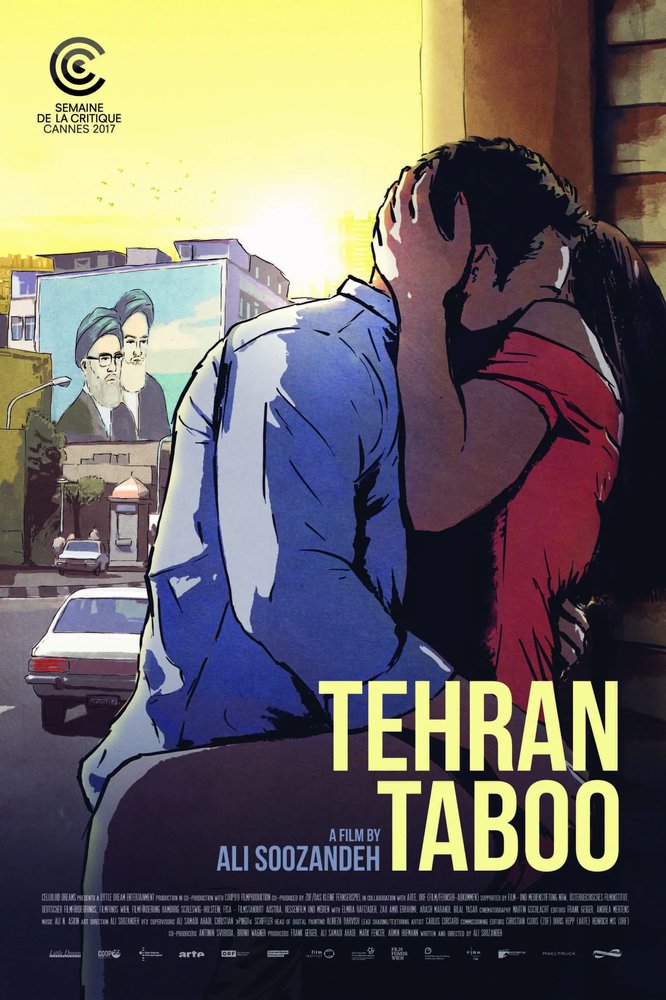
Tehran Taboo

Tehran Taboo (Teheran Tabu)

Movie · 2017 · 11 people

Three women and a musician whose paths cross in Tehran, each struggling to cope with Iran's strict religious rules and the double standards they breed, are the focus of Tehran Taboo. Ali Soozandeh wrote and directed this 2017 German-Austrian adult animated drama in Persian; his first live-action feature, it played in the Critics' Week section of the 2017 Cannes Film Festival and took the Rails d'Or Grand Prize there.

The film was made with rotoscoping: real actors were filmed against green screens, and Tehran settings that mix traditional drawings with digital imagery were added behind them afterwards. Elmira Rafizadeh plays Pari, Zar Amir plays Sara, Arash Marandi plays Babak and Bilal Yasar plays Elias. What the characters share is a search for freedom and happiness under prohibitions and restrictions, and the position of women and a sex life hemmed in by religious bans run through the story.

The 96-minute film had its world premiere on 20 May 2017, was shown at the Viennale on 29 October 2017 and opened in Germany on 16 November and in Austria on 30 November 2017. Its United States release followed in February 2018.

DirectorAli Soozandeh
Production companycoop99

Reactions

You can pick up to 3 reactions.

Cast

Only cast members with a profile on this site are listed.

Hasan Ali Mete Hasan Ali Mete Actor · 60 years old Şiir Eloğlu Şiir Eloğlu Actor · 60 years old Elmira Rafizadeh Alireza Bayram Arash Marandi Zahra Amir Ebrahimi Thomas Nash Klaus Ofczarek Morteza Tavakoli Aida Loos Adem Karaduman

Through different eyes

Cinephile Looks at script, editing and directing choices; keeps a distance from formula films.

Rotoscoping here is not decoration but a solution. Keeping the real actors' movement while rebuilding Tehran from drawings and digital layers gives Soozandeh full control over his city, and fine-grained performances still show through the line work. The method has a cost, in my view: figures and backgrounds sometimes feel detached from each other, and the image can turn into a chilly shop window. The intersecting storylines also don't give every character the same depth; some never become more than connectors. Not flawless, but a bold experiment that asks its question through its form, and it earned that Cannes prize.

History & Society Lens Asks about the period, the social background and what the work reflects.

The film's real subject is less the prohibitions themselves than the double standards they breed. The rules look equally strict for everyone, yet the film is good at showing that they do not fall on everyone with the same weight. That keeps the stories of three women and a musician from shrinking into a single critique of the system; instead it looks at the small bargains of everyday life, hidden desires and the cornered position of women. What makes it valuable is that it never lectures. Rather than hand down verdicts, it exposes a city's inner contradictions and leaves the conclusions to the viewer.

Family Viewer Asks whether the whole household can watch it; cares about humour and heart.

Don't be fooled by the animation: this is a drama made for adults. Heavy subjects such as religious pressure and a sex life hemmed in by bans sit right at the centre of the story. It is not one to put on with the children or the grandparents. For an adult viewer, though, it leaves plenty to talk about. For a family evening, pick something else.

These are not reader reviews: they are short editorial takes written from different viewer perspectives with AI assistance. Reader reviews are below.

Reviews (0)

Log in Log in to write a review.

Comments