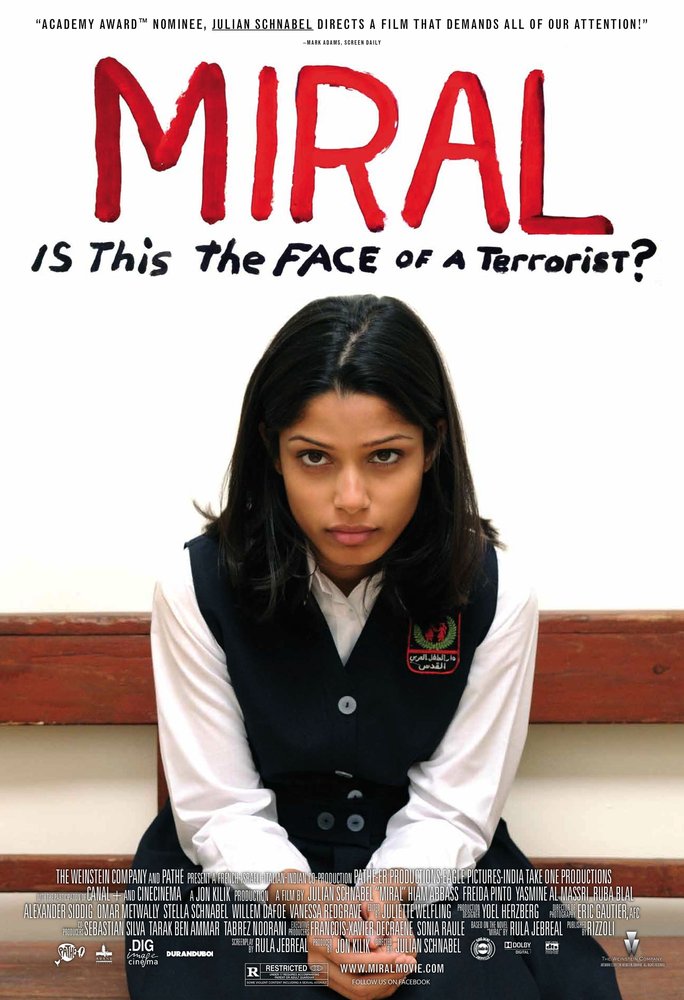
Miral

Miral

Movie · 2010 · 15 people

Julian Schnabel directed the 2010 drama Miral, also classed as a historical film. Running about 112 minutes, it is based on a screenplay that Rula Jebreal adapted from her own novel. It is a co-production of France, Italy, Israel, India and the USA, shot in color with dialogue in Arabic, English and Hebrew. The musician Tom Waits also contributed to the music. The film had its premiere at Venice on 3 September 2010 and opened in France about two weeks later.

The story is set in Jerusalem, a city held sacred by the three Abrahamic faiths. Miral, a Palestinian girl born and raised there after the 1948 Arab-Israeli war, spends her birth, childhood and early youth in conditions of conflict. The tension around her draws her toward resistance, as a young woman taking part in the intifada, and the film asks whether she can keep her anger and feelings under control. Another strand follows Hind Husseini, an idealistic woman who takes in children orphaned by the fighting and tries to give them hope through education. Freida Pinto plays Miral and Hiyam Abbas plays Hind Husseini; Willem Dafoe is Eddie and Ruba Blal is Fatima. The cast also includes Makram Khoury, Vanessa Redgrave and Alexander Siddig.

DirectorJulian Schnabel
Production companyPathé

Reactions

You can pick up to 3 reactions.

Cast

Only cast members with a profile on this site are listed.

Hiyam Abbas Hiyam Abbas Film actor · 65 years old Makram Khoury Makram Khoury Film actor · 81 years old Freida Pinto Yasmine Al Massri Alexander Siddig Omar Metwally Willem Dafoe Vanessa Redgrave Ruba Blal Doraid Liddawi Shredy Jabarin Lana Zreik Jamil Khoury Salwa Nakkara Sharon Alexander

Through different eyes

History & Society Lens Asks about the period, the social background and what the work reflects.

Miral tells the story of post-1948 Jerusalem through the eyes of a young Palestinian woman and focuses on how conflict shapes children and the young above all. In my view the film's most valuable aspect is the tension it sets up between being drawn towards resistance and finding hope through education: Hind Husseini, who takes in children orphaned by the war, forms the story's second axis as a different answer to violence. Basing the script on Rula Jebreal's own novel gives the narrative personal authenticity, though it is worth keeping in mind that this is a story told from a particular point of view. Arabic, English and Hebrew spoken side by side also reflect the region's intertwined reality.

Cinephile Looks at script, editing and directing choices; keeps a distance from formula films.

The film builds a two-axis structure split between Hind Husseini and Miral. That makes the idea of a handover between generations visible but risks narrowing the room given to the title character's inner life. The wide span of time, from birth to early youth, also pushes the narrative towards an episodic shape; turning points can follow one another without deepening. Tom Waits's contribution to the music is an unexpected and interesting touch. The real question is whether the issue at the film's centre, whether the young heroine can master her anger, turns into dramatic tension. In my view Julian Schnabel is better at posing that question than at making it grow inside the viewer.

Family Viewer Asks whether the whole household can watch it; cares about humour and heart.

Miral is not a film for relaxed family viewing. It is about a girl growing up amid conflict, children orphaned by war and being drawn into resistance; the subject is heavy and harsh. It is not suitable for young children. High-school-age teens curious about the region's history can watch it with adults and talk it over. There is a hopeful side as well: a woman trying to give children hope through education.

These are not reader reviews: they are short editorial takes written from different viewer perspectives with AI assistance. Reader reviews are below.

Reviews (0)

Log in Log in to write a review.

Comments