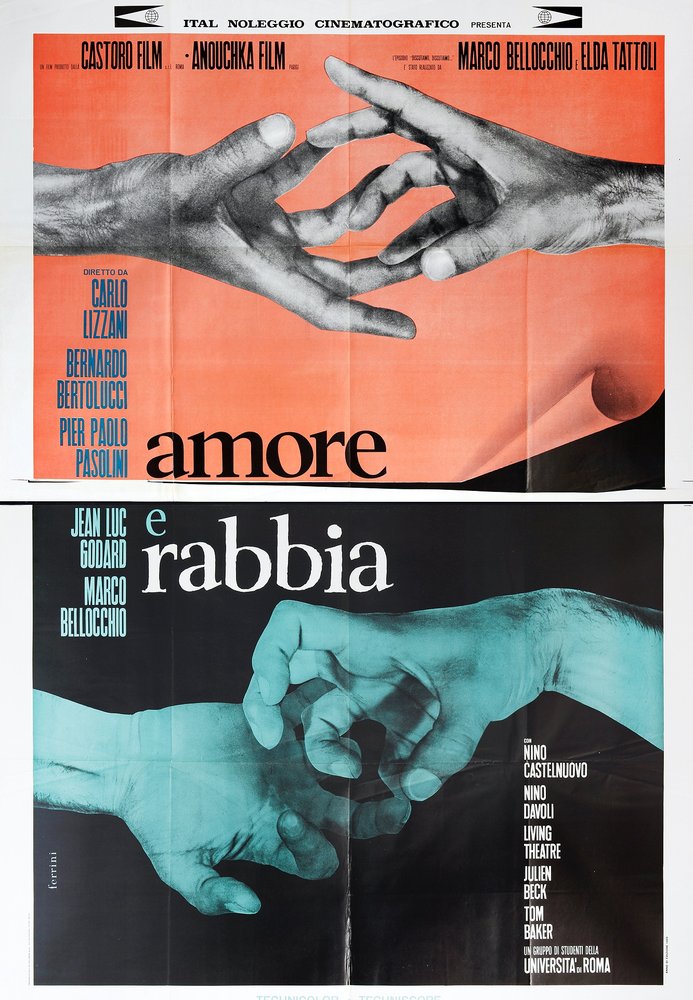
Love and Anger

Love and Anger (Amore e rabbia)

Movie · 1969 · 14 people

Released internationally as Love and Anger, Amore e rabbia came in 1969 as an Italian-French anthology film. It consists of five short segments with no narrative link, each built from its own director's idea and script. The film set out to bring a secular, modern outlook to the Gospel texts, and it was first shown under the title Vangelo '70 at the 19th Berlin International Film Festival in 1969. In France it is also known as La Contestation.

The five segments were entrusted to leading names of art cinema: Carlo Lizzani's Indifference, Bernardo Bertolucci's Agonia, Pier Paolo Pasolini's With the Paper Flower, Jean-Luc Godard's Love and Marco Bellocchio's Let's Discuss, Let's Discuss. The segments deal with love and violence and with the events of the late sixties and the people involved in them. Some sources add Elda Tattoli as a sixth director. The performers include Milena Vukotic, Nino Castelnuovo, Julian Beck, Judith Malina, Ninetto Davoli, Jim Anderson, Adriano Aprà, Petra Kandarr and Catherine Jourdan.

The film runs about 100 minutes and is a joint production of Castoro, Ital-Noleggio Cinematografico and Anouchka Films. Giovanni Fusco wrote the music. It was shot in 1968 and is also dated to a 29 May 1969 premiere.

DirectorJean-Luc Godard, Marco Bellocchio
Production companyCastoro, Ital-Noleggio Cinematografico, Anouchka Films

Reactions

You can pick up to 3 reactions.

Cast

Only cast members with a profile on this site are listed.

Milena Vukotic Milena Vukotic Actor · 91 years old Nino Castelnuovo Nino Castelnuovo Actor · died at 84 Marco Bellocchio Julian Beck Jim Anderson Judith Malina Adriano Aprà Petra Kandarr Tom Baker Ninetto Davoli Aldo Puglisi Fernaldo Di Giammatteo Catherine Jourdan James Anderson

Through different eyes

Cinephile Looks at script, editing and directing choices; keeps a distance from formula films.

Bringing Lizzani, Bertolucci, Pasolini, Godard and Bellocchio together in one film is, on paper, a summit of art cinema. But the lack of any narrative link between the segments makes the classic problem of anthology films obvious here too: the result is not a unified work but five independent essays. The idea of bringing a secular, modern outlook to the Gospels tries to build common ground, yet each director stays so loyal to his own idiom that tone and quality vary noticeably from one segment to the next. So the film says more when watched not as a whole but as a set of footnotes to its directors' careers.

History & Society Lens Asks about the period, the social background and what the work reflects.

Shot in 1968 and shown in Berlin in 1969 as Vangelo '70, the film is one of cinema's direct traces of the ferment of the late sixties. Its French title, La Contestation, meaning 'protest', sums up the mood of the time. Dealing with love, violence and the events of those years, the segments carry an urge to interpret what was happening in the streets while it was still hot. That is why it reads today mostly as a period document: the wish to bring religious texts face to face with the problems of modern society clearly reflects that generation's tense relationship with tradition. A rich source for anyone curious about the questions on artists' minds back then.

Yeşilçam Nostalgic A viewer raised on the classics, looking for warm storytelling and strong acting.

Seeing the names of Pasolini, Bertolucci and Godard on one film is an invitation in itself. But for a viewer who looks to the classics for warm storytelling and characters to care about, this film stays far too cold. The anger in its title is no accident: the segments speak to the mind and to protest rather than to the heart, and an emotional centre to hold on to is hard to find. A heart used to Yeşilçam's sincere, plain storytelling will struggle to feel at home here, yet it is worth seeing once for anyone curious about what great masters were searching for in those years.

These are not reader reviews: they are short editorial takes written from different viewer perspectives with AI assistance. Reader reviews are below.

Reviews (0)

Log in Log in to write a review.

Comments