French Connection II

French Connection II

Movie · 1975 · 15 people

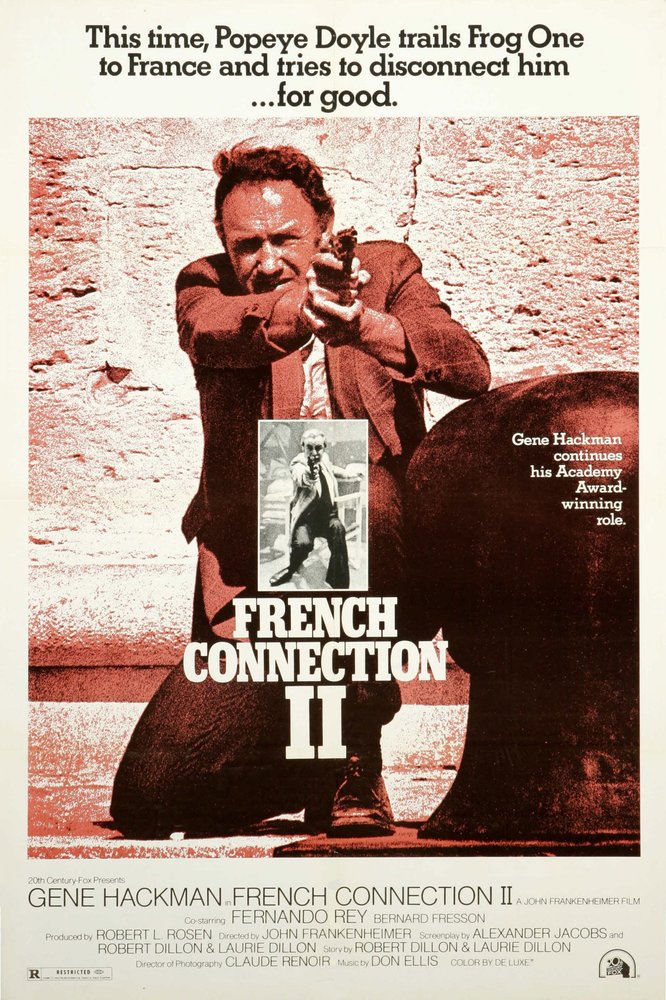
John Frankenheimer directed French Connection II, the 1975 follow-up to The French Connection, William Friedkin's 1971 film that had won the Oscar for Best Picture. This American neo-noir action thriller runs about 119 minutes. A mix of crime, drama and police procedural, it was made under the 20th Century Fox banner. On release it drew generally good reviews and was a commercial success.

Gene Hackman again plays New York detective Jimmy "Popeye" Doyle. This time Doyle travels to Marseille to track down the French drug dealer who escaped him at the end of the first film, Alain Charnier, played by Fernando Rey. Hackman and Rey are the only cast members to return. Bernard Fresson, Philippe Léotard, Ed Lauter and Charles Millot also appear.

Alexander Jacobs wrote the screenplay. The first film was based on a true story; this sequel's script is entirely fictional and focuses even more on Doyle's character. Working far from home, in a city whose language he does not speak and under the watch of local police, the detective's hunt plays out in the port's underworld. Much of the shooting took place in Marseille. A third film made for television in 1986, Popeye Doyle, featured other actors in the lead roles.

DirectorJohn Frankenheimer
Production company20th Century Fox

Reactions

You can pick up to 3 reactions.

Cast

Only cast members with a profile on this site are listed.

Charles Millot Charles Millot Actor · died at 81 Philippe Brizard Actor · died at 87 Gene Hackman Fernando Rey Bernard Fresson Philippe Léotard Ed Lauter Jean-Pierre Castaldi Cathleen Nesbitt Jacques Dynam Pierre Collet Jean-Pierre Zola Alexandre Fabre André Penvern Hal Needham
Through different eyes

Action & Thriller Fan Puts pace, tension and set pieces first; little patience for slow drama.

Dropping Popeye Doyle in Marseille is a great idea: chasing a drug trafficker through the dark world of the port, in a city whose language he doesn't speak, with the local police watching him. It is a set-up that raises the stakes with every step. My only warning: the film focuses on Doyle as a character even more than before, so anyone expecting non-stop chases may need some patience in places.

Cinephile Looks at script, editing and directing choices; keeps a distance from formula films.

Sequels usually try to repeat the first film's success; Frankenheimer instead chooses to move away from Friedkin's Oscar winner rather than imitate it. The first film was based on a real case, and a wholly fictional script means losing that documentary feel, but in exchange it gets to look at Doyle far more closely. By cutting him off from his home and his language, the film turns the police-thriller template into a study of alienation, and in my view that is the most interesting thing about this sequel. There is a cost: the more room the character study takes, the more the hunt risks fading into the background, and Charnier's threat may feel less sharp than in the first film.

History & Society Lens Asks about the period, the social background and what the work reflects.

The film takes the drug trade out of being a New York problem and shows it as a network linking both sides of the Atlantic. The port of Marseille is not just a backdrop here; it is a world where an American detective doesn't know the language, is a stranger to the rules and has to operate under the eye of the local police. That foreignness also makes you think about how helpless American law enforcement can be beyond its borders. Shooting largely in Marseille brings the city's texture into the film. In my view, though, because the story is told through Doyle's eyes, the French characters tend to be positioned as help or hindrance rather than as people with worlds of their own.

These are not reader reviews: they are short editorial takes written from different viewer perspectives with AI assistance. Reader reviews are below.

Reviews (0)

Log in Log in to write a review.

Comments