Dogville

Dogville

Movie · 2003 · 15 people

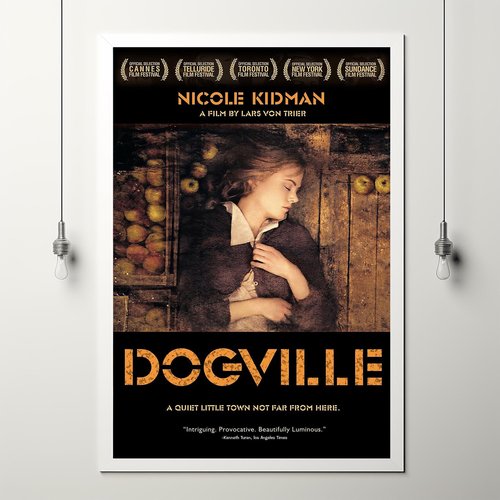
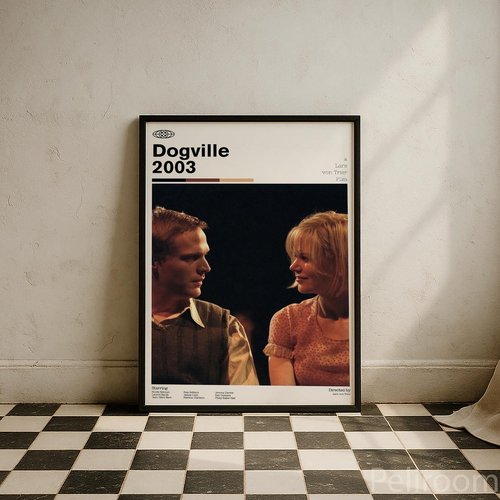
Danish filmmaker Lars von Trier wrote and directed Dogville, a 2003 experimental arthouse drama and an international co-production including France, Germany and the United Kingdom. It is the first film in von Trier's "USA: Land of Opportunities" trilogy; Manderlay (2005) followed, and Washington was never made. It competed at Cannes in 2003, where the Palme d'Or went to Gus Van Sant's Elephant.

The story is set in 1930s America, in the tiny Colorado mountain town of Dogville. Grace (Nicole Kidman), on the run from gangsters, is allowed to stay in return for everyday work. Her stay depends on winning over every resident, and help turns to exploitation and humiliation until the refuge becomes a prison. The cast includes Paul Bettany, Lauren Bacall, Chloë Sevigny, Stellan Skarsgård, Udo Kier, Ben Gazzara and James Caan, with John Hurt as narrator.

The film is staged like a play: the houses are only outlines marked on a studio floor, with no doors or walls. It runs 177 minutes, though a 132-minute cut reached most cinemas. It is dedicated to Katrin Cartlidge. Reviews split sharply: some found it pretentious, others a masterpiece. Its standing has grown, and in 2016 it placed 76th in the BBC critics' poll of the 21st century. Tarantino has praised it.

DirectorLars von Trier
Production companyCanal+
Dogville Dogville

Reactions

You can pick up to 3 reactions.

Cast

Only cast members with a profile on this site are listed.

Jean-Marc Barr Jean-Marc Barr Actor · 66 years old Udo Kier Udo Kier Actor · died at 81 Nicole Kidman Paul Bettany Stellan Skarsgård Chloë Sevigny Siobhan Fallon Hogan John Hurt James Caan Philip Baker Hall Lauren Bacall Patricia Clarkson Jeremy Davies Ben Gazzara Blair Brown

Through different eyes

Cinephile Looks at script, editing and directing choices; keeps a distance from formula films.

Dogville's boldest decision is reducing the town to outlines on a floor with no walls. This stage-play aesthetic pulls the viewer out of the illusion of realism and onto the moral experiment itself; in a space where everything is visible, no one can claim not to know what is going on. John Hurt's narration also gives the film a distanced, parable-like frame. On the other hand the method has a heavy cost: the length and the successive rounds of humiliation keep going after the point has been made, lending some weight to those who found it pretentious. In my view, love it or not, Dogville is an experiment that deserves its place at the centre of the debate about form in this century's arthouse cinema.

History & Society Lens Asks about the period, the social background and what the work reflects.

Although it is set in 1930s America, the film's real subject is a model of community rather than a particular era. Tying a fugitive's refuge to everyday labour shows how hospitality can turn into bargaining and then into domination. Making Grace's stay depend on every resident's approval is a sharp observation about how small communities keep outsiders under control. The trilogy's 'Land of Opportunities' label announces an ironic look at the American dream from the start, so it is no surprise some critics read the film as anti-American. To my mind the parable could be set anywhere; America works here more as a mirror.

Family Viewer Asks whether the whole household can watch it; cares about humour and heart.

This is not a family-night film. It is about help offered to a woman on the run turning into exploitation and humiliation, a heavy and disturbing story. It should not be watched with children or younger teens. Staged like a play and very long, it can tax even adults. Grown-ups should watch it on their own, ready to talk it through afterwards.

These are not reader reviews: they are short editorial takes written from different viewer perspectives with AI assistance. Reader reviews are below.

Reviews (0)

Log in Log in to write a review.

Comments