Brahms'ı Sever misiniz?

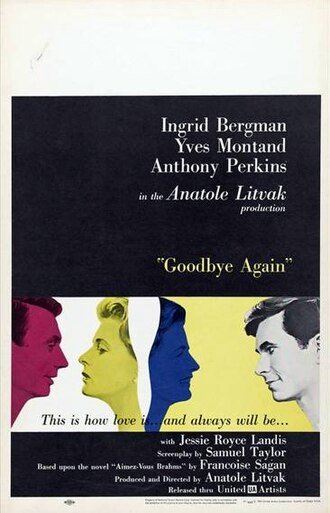
Goodbye Again (Aimez-vous Brahms…)

Movie · 1961 · 15 people

Anatole Litvak both directed and produced Goodbye Again, a French-American romantic drama of 1961 shown in France as Aimez-vous Brahms?. Samuel A. Taylor's screenplay draws on the bestselling 1959 novel by Françoise Sagan. The film was a Palme d'Or contender at the Cannes Film Festival in May 1961, where Anthony Perkins took the best actor prize. The English title comes from a jazz number sung by Diahann Carroll in a nightclub scene.

Paula (Ingrid Bergman), a mature and successful interior designer in Paris, is left lonely by her long-term lover Roger (Yves Montand), who often neglects her. She finds comfort in Philip (Anthony Perkins), the young son of an American client. As Philip's gentle attention absorbs her, Roger promises to give up his infidelities and proposes marriage to win her back. A classic older-woman, younger-man story, it also features Jessie Royce Landis, Pierre Dux, Michèle Mercier and Peter Bull, with brief appearances by Yul Brynner, Jean-Pierre Cassel, Sacha Distel and Sagan herself.

Georges Auric wrote the score, and its main themes are taken from Brahms's First and Third Symphonies. Christian Dior designed Bergman's costumes. In Istanbul it played at the Emek cinema in the 1961-1962 season.

DirectorAnatole Litvak
Production companyUnited Artists

Reactions

You can pick up to 3 reactions.

Cast

Only cast members with a profile on this site are listed.

Dominique Zardi Actor · died at 79 Henri Attal Henri Attal Actor · died at 67 Ingrid Bergman Anthony Perkins Yves Montand Jessie Royce Landis Pierre Dux Michèle Mercier Uta Taeger Peter Bull Diahann Carroll Françoise Sagan Georges Sellier Germaine Delbat Hélène Tossy
Through different eyes

Cinephile Looks at script, editing and directing choices; keeps a distance from formula films.

Litvak stages Sagan's bestseller as an elegant romantic drama: costumes by Dior, a Georges Auric score drawn from Brahms's symphonies and a Paris setting all show how carefully it was made. The real weight, though, rests on Anthony Perkins, whose performance won best actor at Cannes; Philip's gentle attention forms the emotional axis opposite Bergman's mature, lonely Paula. On the other hand, leaning so heavily on familiar symphonic themes risks handing the audience its emotions ready-made. In my view, wrapping Sagan's melancholy in such a polished surface costs that sadness some of its edge; even so, the balance among the three leads holds the film up.

History & Society Lens Asks about the period, the social background and what the work reflects.

Putting a relationship between a mature woman and a young man at the centre in 1961 was a notable choice given the morals of the time. Paula is a successful interior designer with her own work, a financially independent woman. Yet the story's question is not her career but which of two men she will choose: Roger, unfaithful but now proposing marriage, or young Philip? That framing shows how, in the early 1960s, female independence was still imagined through marriage and social approval. Its run at Istanbul's Emek cinema in the 1961-1962 season is a reminder that Sagan's world reached Turkish audiences in those years too.

Family Viewer Asks whether the whole household can watch it; cares about humour and heart.

This is a love drama made for adults, not children. Loneliness, infidelity and a relationship with an age gap sit at the heart of the story. Teenagers may not find much in it. Fans of classic film stars, and Ingrid Bergman admirers in particular, could enjoy it as an evening film. For younger children it is slow and very much a grown-up story.

These are not reader reviews: they are short editorial takes written from different viewer perspectives with AI assistance. Reader reviews are below.

Reviews (0)

Log in Log in to write a review.

Comments