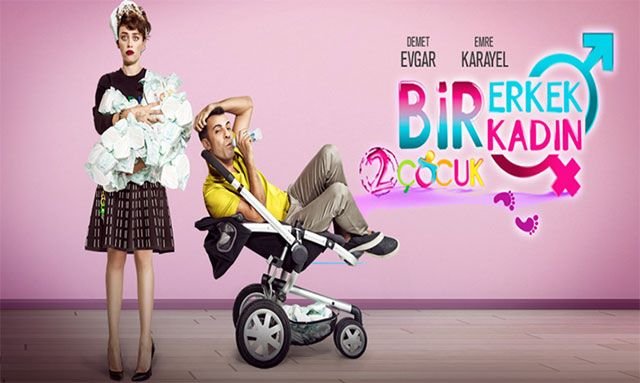
1 Erkek 1 Kadın 2 Çocuk

1 Man, 1 Woman, 2 Children (1 Erkek 1 Kadın 2 Çocuk) (translated)

TV Series · 2014–2015 · 4 people

Bando Yapım made the Turkish situation comedy 1 Erkek 1 Kadın 2 Çocuk (1 Man, 1 Woman, 2 Children). The title belongs to the FOX period of a series that began in 2008 as 1 Kadın 1 Erkek and ran until 2015 on Turkmax, Star TV and then FOX. It is the Turkish version of the format Un gars, une fille, which started in Canada in 1997. Its promotion stresses a funny take on relationships and says it quickly hooked viewers.

The story is built on the relationship and everyday life of Zeynep and Ozan. Scenes unfold at home, in the car, while shopping, at the mother-in-law's house, on holiday, at the gym and almost anywhere else, boldly playing out comic situations any couple might face. Demet Evgar plays Zeynep and Emre Karayel plays Ozan.

It started on Turkmax on 2 October 2008, moved to Star TV in 2012 and left it after episode 375 on 8 December 2013. When it returned on FOX on 11 September 2014 it used this title from episode 388 onward, and it ended for the third time with episode 416 on 8 April 2015, after eight seasons in all. Müge Turalı, Mehmetcan Yüksel and Melda Perahya Yalçın are named among the producers and Ece Beyter among the executive producers.

Production companyBando Yapım
NetworkTurkmax, Star TV, FOX

Reactions

You can pick up to 3 reactions.

Cast

Through different eyes

Series Binger A series devotee tracking character arcs, cast chemistry and season pacing.

This show's story is almost as interesting as its broadcast history: a run that began on Turkmax, moved to Star TV, paused and returned on FOX under a new title, stretching over eight seasons. The secret to surviving that long is the chemistry of the couple carrying the whole load; Zeynep and Ozan's relationship is the series' one and sufficient backbone. To be honest, though, after hundreds of episodes the short situational sketches start repeating themselves. The new title promises freshness, but the formula stays essentially the same; for those who have watched from the start it is a familiar continuation, for newcomers an easy place to jump in.

Cinephile Looks at script, editing and directing choices; keeps a distance from formula films.

The Turkish adaptation of Un gars, une fille, a format born in Canada, rests on an extremely bare structure: two characters, short scenes and everyday settings that change from the home to the car, from shopping to the gym. That minimalism is formally bold; instead of sets and a crowd of supporting characters it leaves everything to timing and the rhythm of the dialogue. That is exactly where the problem starts: the sketch logic leaves little room for the characters to really change across episodes. The situations are renewed, but the relationship itself largely marks time. A system that works within a short episode turns, once spread over many years, into a series of variations rather than a narrative. Still, it is an instructive example of how a television comedy format can be localised.

History & Society Lens Asks about the period, the social background and what the work reflects.

The series is like a mirror held up to the urban Turkish couple of the late 2000s and the 2010s: small arguments at home, visits to the mother-in-law, holiday plans, the gym. Putting everyday life so firmly at the centre shows what was up for negotiation in middle-class marriage of the period. On the other hand, couple comedies of this kind often risk leaning on male and female clichés; the humour sometimes comes from repeating familiar patterns rather than observing the relationship. Still, the fact that a foreign format held on for so long suggests that viewers recognised their own marriages on screen.

These are not reader reviews: they are short editorial takes written from different viewer perspectives with AI assistance. Reader reviews are below.

Reviews (0)

Log in Log in to write a review.

Comments