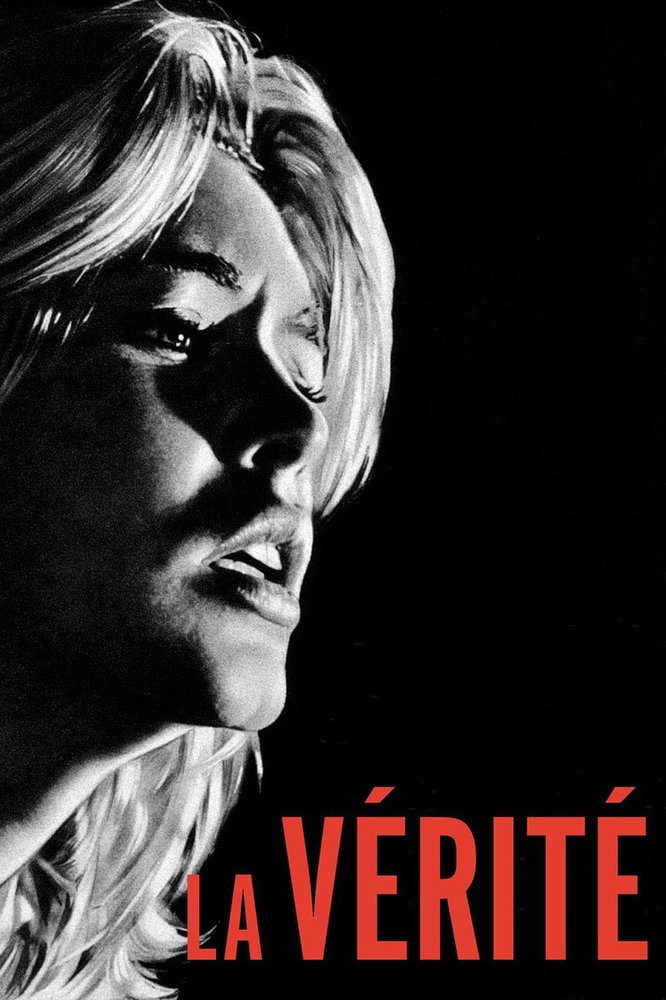
The Truth

The Truth (La Vérité)

Movie · 1960 · 15 people

Henri-Georges Clouzot directed La Vérité (The Truth in English), a black-and-white French-Italian film from 1960. It combines courtroom drama, love story and crime film, telling its story through flashbacks. The 124-minute production opened in France on 2 November 1960. It brought Brigitte Bardot her first recognition as a serious actress. The film took the Golden Globe for best foreign-language film and was nominated for the Oscar in the same category.

The story unfolds at the trial of Dominique Marceau (Brigitte Bardot), a young woman without steady work. She is accused of killing her former lover Gilbert Tellier, an ambitious young conductor fresh out of the conservatoire, who had just become engaged to her sister Annie. The prosecution holds that the killing was carefully planned, the defence that it came from a sudden burst of emotion. At the hearings Gilbert's acquaintances, Dominique's former lovers and her violinist sister Annie testify, and each account adds detail to the couple's relationship and to Dominique's character. The cast also includes Sami Frey, Charles Vanel, Paul Meurisse, Marie-José Nat and Jacques Perrin.

Clouzot, Christiane Rochefort and Véra Clouzot wrote the screenplay; the film draws on Rochefort's literary work and was inspired by a real case, the Pauline Dubuisson trial.

DirectorHenri-Georges Clouzot

Reactions

You can pick up to 3 reactions.

Cast

Only cast members with a profile on this site are listed.

Dominique Zardi Actor · died at 79 Laure Paillette Laure Paillette Film actor · died at 71 Brigitte Bardot Charles Vanel Paul Meurisse Sami Frey Jacques Perrin Marie-José Nat Louis Seigner Jean-Loup Reynold Albert Michel André Oumansky Barbara Sommers Betty Beckers Charles Bouillaud
Through different eyes

Cinephile Looks at script, editing and directing choices; keeps a distance from formula films.

Clouzot's smartest choice is to set the story in the courtroom and open up the past through flashbacks tied to the testimony. The film thus asks less how a murder was committed than how a woman is narrated by others; each statement turns Dominique a little more into a figure built by other people. The black-and-white images give a plain setting for the contrast between the coldness of the court and the passion of the past. It is no surprise that this film brought Bardot her first recognition as a serious actress; the role asks her to move beyond her image. Even so, as the flashbacks pile up the storytelling turns repetitive in places and the film feels somewhat longer than it needs to.

History & Society Lens Asks about the period, the social background and what the work reflects.

Inspired by the Pauline Dubuisson case, the film is a notable record of how a young woman without steady work who lived on her own terms was judged in 1960 France. Hearing her former lovers as witnesses shifts the trial's question from the killing to the woman's character, and the prosecution-versus-defence argument over planning or a sudden burst of emotion becomes, in effect, an argument about what kind of woman Dominique is. Her violinist sister Annie taking the stand also invites a comparison, through the two sisters, of the different roles the era assigned to women. The film makes you sense that the court is no neutral space but one that carries society's moral yardsticks inside with it.

Action & Thriller Fan Puts pace, tension and set pieces first; little patience for slow drama.

For a courtroom drama the pace is decent: the clash between prosecution and defence keeps the case alive and the flashbacks keep curiosity up. Anyone expecting a classic crime thriller may be surprised, though. The film is interested not in who did it but in why, and in what state of mind. The long witness statements do slow the rhythm now and then.

These are not reader reviews: they are short editorial takes written from different viewer perspectives with AI assistance. Reader reviews are below.

Reviews (0)

Log in Log in to write a review.

Comments