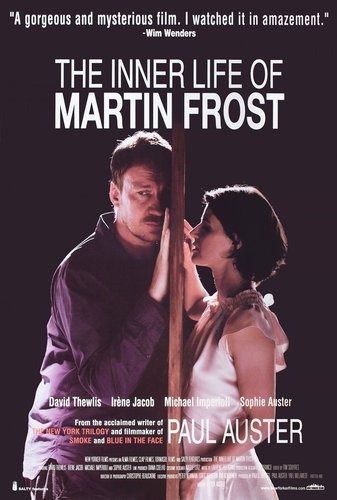
The Inner Life of Martin Frost

The Inner Life of Martin Frost

Movie · 2007 · 4 people

Author Paul Auster wrote and directed The Inner Life of Martin Frost, a 2007 romantic mystery drama with fantasy elements too. Shot in English, it turns a film imagined in Auster's novel The Book of Illusions into a real feature. It is his second film as director and fourth as writer. A co-production of the United States, France, Portugal and Spain, it had a reported budget of about 3.5 million euros.

Writer Martin Frost, done with his fourth novel after three years of work, retreats to a friend's empty country house for a few weeks alone, where he sets out on a new story. The next morning he wakes next to a beautiful stranger: Claire, who says she is the owner's niece, moves in, the two share the house, respecting each other's space, and a romance begins. One question nags at Martin, though: is Claire who she says she is? David Thewlis plays Martin Frost and Irène Jacob plays Claire, with Michael Imperioli as James Fortunato and Sophie Auster as Anna James.

It was shot in spring 2006 at Azenhas do Mar in Sintra, Portugal. The film premiered at the New Directors/New Films Festival on March 21, 2007, and opened in the United States on September 7, 2007.

DirectorPaul Auster

Reactions

You can pick up to 3 reactions.

Cast

Names without a link have no profile here yet.

Irène Jacob Irène Jacob Film actor · 60 years old Claire Martin David Thewlis Michael Imperioli Sophie Auster

Through different eyes

AI-assisted editorial takes written from different viewer perspectives. They are not reader reviews; those are below.

Cinephile Looks at script, editing and directing choices; keeps a distance from formula films.

The Inner Life of Martin Frost is an attempt to make real a film imagined inside a novel, and the idea is appealing in itself. Paul Auster the director, however, stays in the shadow of Paul Auster the writer. The film tends to carry its story through words and ideas rather than images, and its sense of mystery comes more from dialogue than from editing. The result is an elegant but somewhat static chamber piece. This small fable about writing and writers will say more to readers who love Auster's fiction; those who want a strong visual language from cinema may stay at arm's length.

History & Society Lens Asks about the period, the social background and what the work reflects.

This film offers little to anyone looking for a social backdrop, and it does so on purpose. A co-production of the United States, France, Portugal and Spain, it shuts its story inside an empty country house cut off from the world; period, class and city hardly come into it. That isolation is a fitting frame for a writer withdrawing into himself. On the other hand, the film takes the value of writing and solitude for granted instead of questioning it. It works as a quiet reflection on the artist's solitude, but it has nothing to say about its own time.

Family Viewer Asks whether the whole household can watch it; cares about humor and heart.

It is an adult love story and a look inside a writer's head, with a calm pace and no big events. A story that stays inside his mind holds nothing for children, and teenagers will probably lose interest too. Better suited to adults who want something thoughtful on a quiet evening. Not for anyone after family entertainment.

Reviews (0)

Log in Log in to write a review.

Comments