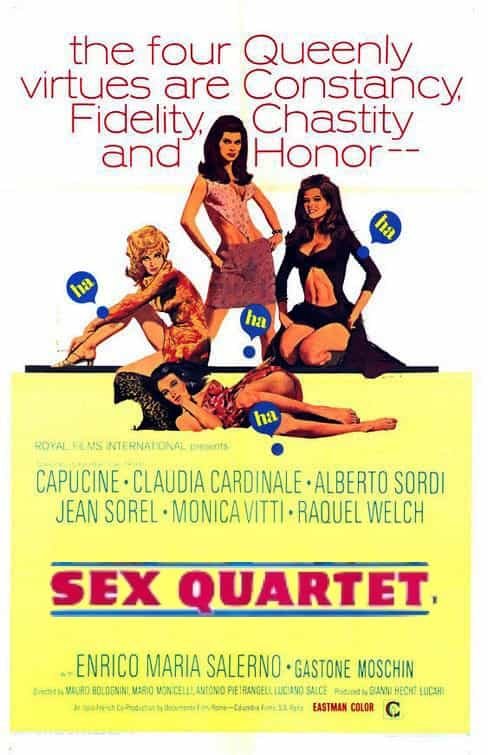
Sex Quartet

Sex Quartet (Le fate)

Movie · 1966 · 15 people

Four directors — Mario Monicelli, Mauro Bolognini, Antonio Pietrangeli and Luciano Salce — each made one of the separate tales in Sex Quartet (in Italian Le fate, “The Fairies”), a 1966 Italian-French comedy anthology shot in Italian and running about 110 minutes. Abroad it went out as The Queens in the United States, Les Ogresses in France, Die Gespielinnen in Germany, Las cuatro brujas in Spain, Las reinas in Latin America and As Rainhas in Brazil.

The four leads are Monica Vitti, Claudia Cardinale, Raquel Welch and Capucine, then among the best-known actresses of the day; the tales follow the satirical manner of Italian comedy of the period and keep their female characters in front. The cast also includes Alberto Sordi, Enrico Maria Salerno, Gastone Moschin, Jean Sorel and Anthony Steel, with Corrado Olmi, Gigi Ballista, Maria Cumani Quasimodo and Jole Fierro among the others.

The screenplay is credited to Suso Cecchi d'Amico, Ruggero Maccari and Luigi Magni, along with Rodolfo Sonego. Columbia Pictures is the production company. The film opened in Italy on 22 November 1966 and in West Germany on 31 August 1967.

DirectorMario Monicelli, Mauro Bolognini
Production companyColumbia Pictures

Reactions

You can pick up to 3 reactions.

Cast

Only cast members with a profile on this site are listed.

Claudia Cardinale Claudia Cardinale Actor · died at 87 Alberto Sordi Alberto Sordi Film actor · died at 82 Monica Vitti Enrico Maria Salerno Gastone Moschin Jean Sorel Capucine Raquel Welch Maria Cumani Quasimodo Jole Fierro Olga Villi Anthony Steel Renzo Giovampietro Corrado Olmi Gigi Ballista

Through different eyes

Yeşilçam Nostalgic A viewer raised on the classics, looking for warm storytelling and strong acting.

Bringing together Monica Vitti, Claudia Cardinale, Raquel Welch and Capucine, Sex Quartet is like a postcard from 1960s Italian comedy. Alberto Sordi's presence alongside them is a reason in itself for anyone who misses the stars of that generation. This satirical, elegant manner, from the same years as Yeşilçam's golden age, sits far from today's crude humour. Still, with four separate stories by four directors, don't expect a unified, warm narrative; this is a parade of stars, not a deep story.

Cinephile Looks at script, editing and directing choices; keeps a distance from formula films.

Monicelli, Bolognini, Pietrangeli and Salce: gathering four directors of Italian comedy in one anthology is very tempting on paper. A writing team with Suso Cecchi d'Amico alongside Maccari, Magni and Sonego also inspires confidence in the script. But the familiar weakness of sketch films applies here too: four segments rarely hit the same rhythm and sharpness, and the whole is only as strong as its weakest link. About 110 minutes is a balanced length for four stories but not enough to give each one real depth of character. An interesting example for anyone curious how the satirical comedy of the period was shaped around star performers; placing it on the same shelf as the genre's masterpieces is harder.

History & Society Lens Asks about the period, the social background and what the work reflects.

The film is made up of four stories that put their female characters in front, a notable choice for 1966. But the titles that changed from country to country reveal the gaze through which these women were offered: The Fairies in the original Italian, The Queens in the US, Les Ogresses in France, The Four Witches in Spain, Die Gespielinnen in Germany. The same film was sold in one place as fairy-tale women, in another as dangerous ones, in yet another as playmates. Those titles offer a small but telling picture of how the 1960s star system positioned its actresses. Seen today, the film can be read as a document that both mocks the gender roles of its time and stays inside them.

These are not reader reviews: they are short editorial takes written from different viewer perspectives with AI assistance. Reader reviews are below.

Reviews (0)

Log in Log in to write a review.

Comments