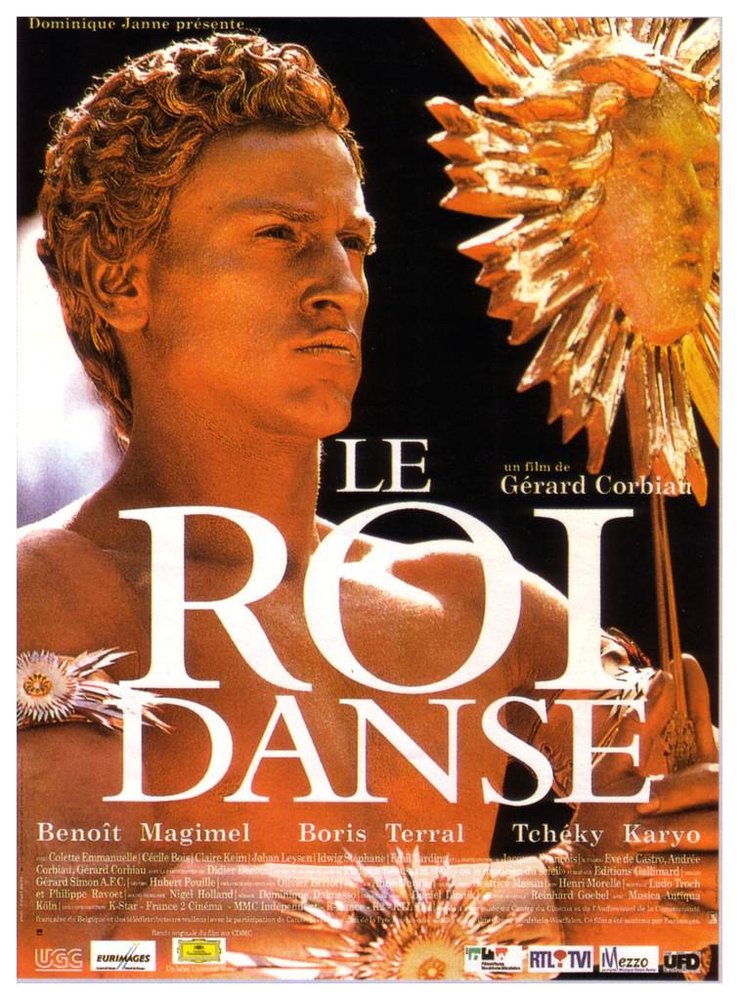
Le Roi danse

Le Roi danse

Movie · 2000 · 15 people

The Belgian director Gérard Corbiau made the 2000 costume drama Le Roi danse, known in English as The King Dances. A co-production of France, Belgium and Germany, it has both musical and biographical features and runs about 108 minutes. Ève de Castro, Corbiau and Didier Decoin wrote the screenplay. Its Spanish release title is La pasión del rey and its German title Der König tanzt. The film received three César nominations.

The story follows the composer and dancer Jean-Baptiste Lully through his career at the court of Louis XIV and his closeness to the king. The film portrays Lully as a libertine and shows him as a natural ally of a king presented as a figure of the early Enlightenment, in the king's conflicts with the Catholic establishment. Beyond his bond with the king, the story covers Lully's camaraderie with Molière and his rivalry with the composer Robert Cambert. Benoît Magimel plays Lully and Tchéky Karyo Molière; the cast also includes Boris Terral, Cécile Bois, Claire Keim, Johan Leysen, Jacques François, Philippe Brizard, Vincent Grass, Caroline Veyt and Ingrid Rouif.

The film is based on the 1992 Lully biography Lully ou le musicien du soleil by the musicologist Philippe Beaussant.

DirectorGérard Corbiau

Reactions

You can pick up to 3 reactions.

Cast

Only cast members with a profile on this site are listed.

Tchéky Karyo Tchéky Karyo Actor · died at 72 Philippe Brizard Actor · died at 87 Benoît Magimel Boris Terral Caroline Veyt Cécile Bois Claire Keim Idwig Stéphane Ingrid Rouif Johan Leysen Jacques François Guy Pion Jean-Louis Sbille Serge Feuillard Vincent Grass

Through different eyes

Cinephile Looks at script, editing and directing choices; keeps a distance from formula films.

For a period film that combines musical and biographical elements, the biggest test is weaving music and dance into the story, and Corbiau's film is ambitious on that front. Lully's identity as composer and dancer offers the chance to lift the court scenes out of static costume display into a story that moves. Its three César nominations suggest that care was recognised. Still, the familiar biopic problem is here too: the friendship with Molière, the rivalry with Cambert and the conflict with the Church open up at once, and not all of them get equal depth. For anyone drawn to Baroque music it remains a rare kind of film.

History & Society Lens Asks about the period, the social background and what the work reflects.

The film presents Louis XIV as something like a figure of the early Enlightenment, and Lully as his natural ally in conflicts with the Catholic establishment. That is interpretation more than history: reading an absolute monarch as a progressive figure is a choice viewers should approach with care. Even so, the film opens an interesting window on the function of art at court, on how music and dance around a ruler became a matter of closeness and power. Its basis in the musicologist Philippe Beaussant's biography of Lully gives added weight to its picture of the period's musical world.

Family Viewer Asks whether the whole household can watch it; cares about humour and heart.

Court, music and dance: at first glance it looks like a costume film for the whole family. But Lully is drawn here as a libertine, and conflicts with the Church take up a good part of the story. The themes speak mostly to adults. Teenagers and grown-ups who love classical music may find it engaging; for young children it will feel heavy.

These are not reader reviews: they are short editorial takes written from different viewer perspectives with AI assistance. Reader reviews are below.

Reviews (0)

Log in Log in to write a review.

Comments