Karanlıkta Dans

Dancer in the Dark

Movie · 2000 · 3 people

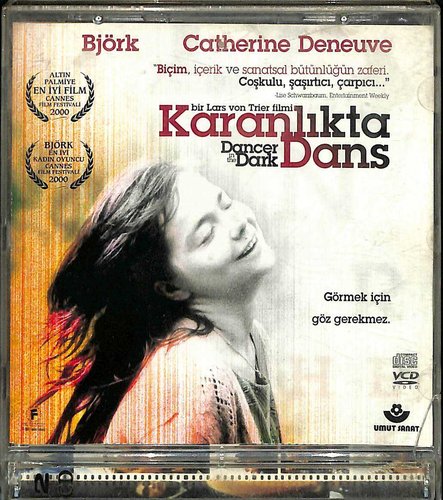
Lars von Trier wrote and directed Dancer in the Dark (Turkish: Karanlıkta Dans), a psychological tragedy musical from 2000. An international co-production with Denmark, Sweden and Germany among its countries, it pairs Dogme 95-inspired handheld camerawork with the style of American musicals of the 1950s and 60s. It is the third and final film of von Trier's "Golden Heart" trilogy, after Breaking the Waves (1996) and The Idiots (1998). It won the Palme d'Or at Cannes.

At the centre is Selma Jezkova, a Czech immigrant working in a factory in America. Selma is losing her sight to a hereditary eye condition, and knowing her young son will inherit it, she saves every cent for his operation. Icelandic singer Björk plays Selma, with Catherine Deneuve, David Morse, Peter Stormare, Joel Grey, Jean-Marc Barr and Udo Kier also in the cast.

The soundtrack was released as the album Selmasongs; Björk wrote most of the music, and von Trier and Sjón supplied some lyrics. "I've Seen It All", performed by Björk and Thom Yorke, was nominated for the Best Original Song Oscar but lost to Bob Dylan's song from Wonder Boys. The film also won Björk the Best Actress prize at Cannes, and although critics were divided, her performance was widely praised.

DirectorLars von Trier
Production companyCanal+
Dancer in the Dark

Reactions

You can pick up to 3 reactions.

Cast

Only cast members with a profile on this site are listed.

Through different eyes

Cinephile Looks at script, editing and directing choices; keeps a distance from formula films.

Lars von Trier sets up a daring clash of forms, pairing Dogme 95-inspired shaky handheld camerawork with the style of 1950s American musicals. The tension between the raw, almost documentary scenes and the musical numbers is both the film's most original and its most divisive feature. Björk's performance more than earns her Best Actress prize at Cannes; it is defenceless, genuine and at times almost unbearably intense. But von Trier's habit of relentlessly amplifying his heroine's suffering corners the viewer emotionally, and at times it feels like manipulation. And 140 minutes is long to carry such a load. Its Palme d'Or is no surprise; nor is the split among critics.

Family Viewer Asks whether the whole household can watch it; cares about humour and heart.

This is not a film for easy family viewing. It is about a mother losing her sight who saves money for her son's operation. It is a very heavy tragedy. There are songs, but don't expect a cheerful musical. It runs 140 minutes, far too long for children. Björk's acting is very moving. Adults can put it on when they are ready for a sad film. Keep the tissues close.

Yeşilçam Nostalgic A viewer raised on the classics, looking for warm storytelling and strong acting.

A mother losing her sight, putting aside every cent she earns for her son's operation... This story carries a heart very close to Yeşilçam's most touching melodramas. Yet the telling is nothing like ours: a trembling camera, an unusual musical structure and a harshness that tightens the chest. Björk plays Selma so sincerely that she recalls the purity of the great performers of old. The song she sings with Thom Yorke lingers long in the mind. Still, for me the film is too merciless; it knows no limit in showing pain and leaves the viewer little room to breathe.

These are not reader reviews: they are short editorial takes written from different viewer perspectives with AI assistance. Reader reviews are below.

Reviews (0)

Log in Log in to write a review.

Comments