Kadın Tuzağı

Immortal (Immortel, ad vitam)

Movie · 2004 · 8 people

Comics master Enki Bilal wrote Immortal (Immortel, ad vitam; in Turkey Kadın Tuzağı) with Serge Lehman and directed it, a science fiction film from 2004. A French-Italian-British co-production, it was shot in English. It loosely adapts the first two books of Bilal's Nikopol trilogy, La Foire aux immortels and La Femme piège.

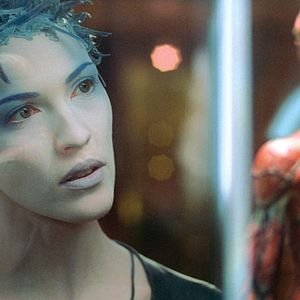
The story is set in New York in 2095. Genetically modified humans live alongside ordinary ones, and anyone entering Central Park is killed on the spot. Above the city, in a strange pyramid, the Egyptian gods put the god Horus on trial. Below, a blue-haired woman named Jill is arrested; examinations show she is not fully human and has seven days left to live. Horus sets out toward her. Linda Hardy, Thomas Kretschmann and Charlotte Rampling take the lead roles.

The film's distinguishing feature is its technique: real actors perform among almost entirely computer-generated sets. With Casshern and Sky Captain and the World of Tomorrow, it is counted among the first major productions shot wholly on a digital backlot. It was shown at Germany's Fantasy Filmfest on 24 July 2004 and reached Turkish cinemas on 30 September 2005. Reviews were mixed, leaning negative.

DirectorEnki Bilal
Production companyTéléma

Reactions

You can pick up to 3 reactions.

Cast

Only cast members with a profile on this site are listed.

Thomas Kretschmann Thomas Kretschmann Actor · 64 years old Jean-Louis Trintignant Jean-Louis Trintignant Character Actor · died at 91 Linda Hardy Charlotte Rampling Frédéric Pierrot Thomas M. Pollard Yann Collette Jacques Bonnaffé

Through different eyes

Cinephile Looks at script, editing and directing choices; keeps a distance from formula films.

Immortal is a comics master's attempt to carry his own pages onto the screen, and its most interesting feature is also its most contentious: real actors performing among almost entirely computer-generated sets and characters. Being named alongside Casshern and Sky Captain and the World of Tomorrow gives it a notable place in the history of the digital backlot. But being first is not the same as being mature; seen today, the difference in texture between live actors and digital figures can weaken the unity of the whole. Squeezing two of Bilal's books into one film as a loose adaptation also seems to struggle to balance the mythological layer with the dystopian city, so the largely negative reviews come as no surprise. Still, it is a bold visual experiment worth noting.

History & Society Lens Asks about the period, the social background and what the work reflects.

The film's picture of the future mirrors the anxieties of the early 2000s well. A New York where genetically modified people live alongside ordinary ones gives shape to the fear that biotechnology could split society into new classes. A detail like anyone entering Central Park being killed on the spot turns the question of who is shut out of urban space into a harsh image. These questions are rich ground, yet as the mythological layer of Egyptian gods and the trial of Horus comes forward, the social dimension tends to slip into the background. Its Turkish release title, Kadın Tuzağı (Woman Trap), also sells the film through a mysterious woman rather than these issues.

Action & Thriller Fan Puts pace, tension and set pieces first; little patience for slow drama.

A digital New York, a pyramid in the sky, Egyptian gods: the visual package definitely grabs you. But this looks more like a film of atmosphere and ideas than an action movie, with mythology and design up front. If you want a fast pace, chases and big fights, it may test your patience. If you are curious about early digital-backlot experiments, give it a shot; if you want adrenaline, look elsewhere.

These are not reader reviews: they are short editorial takes written from different viewer perspectives with AI assistance. Reader reviews are below.

Reviews (0)

Log in Log in to write a review.

Comments