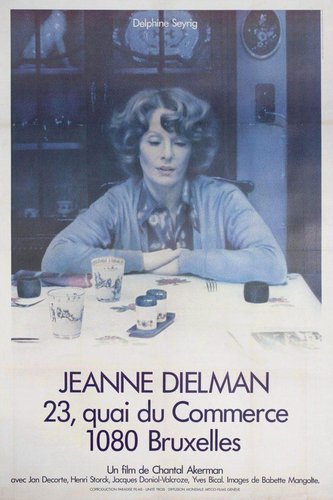
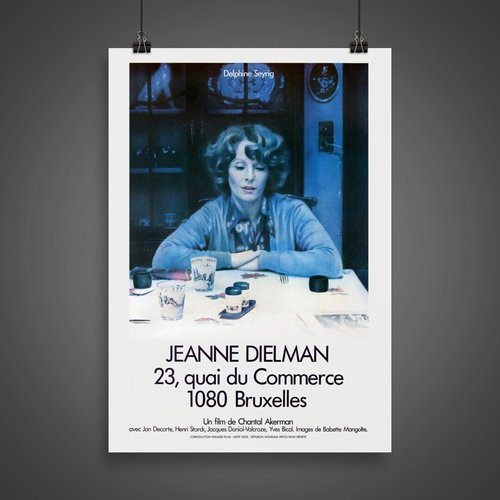
Jeanne Dielman, 23 quai du Commerce, 1080 Bruxelles

Jeanne Dielman, 23 quai du Commerce, 1080 Bruxelles

Movie · 1975 · 3 people

Chantal Akerman wrote and directed Jeanne Dielman, 23 quai du Commerce, 1080 Bruxelles, a Belgian-French art film from 1975. Made in French as drama and experimental cinema, it runs 201 minutes and stars Delphine Seyrig. It is known for long takes, a static camera and its plain view of domestic labour.

The film follows three days in the life of a widowed mother in Brussels. Jeanne lives with her teenage son and fills her days with near-ritual chores. To make ends meet she also receives male clients at home by appointment, leaving her in a closed routine without pleasure. On the third day that routine starts to come apart and her life changes dramatically. Jacques Doniol-Valcroze and Henri Storck play callers.

It was shot on location in Brussels over five weeks and financed by a $120,000 grant from the Belgian government. It premiered on 22 May 1975 in the Directors' Fortnight at Cannes, opened in France on 21 January 1976 to divided reviews. In later decades it was reappraised with Akerman's other work and became a cult classic. Seen as a feminist film and an early slow-cinema example, it placed first in the 2022 Sight and Sound critics' poll, the fourth film to do so and the first directed by a woman.

DirectorChantal Akerman
Jeanne Dielman, 23 quai du Commerce, 1080 Bruxelles Jeanne Dielman, 23 quai du Commerce, 1080 Bruxelles

Reactions

You can pick up to 3 reactions.

Cast

Only cast members with a profile on this site are listed.
Through different eyes

Cinephile Looks at script, editing and directing choices; keeps a distance from formula films.

With its static camera and long takes, Akerman's film insists on showing the moments mainstream editing usually cuts: chores such as cooking, cleaning and shopping unfold almost in their own time, and that time becomes the very subject of the story. Over 201 minutes the routine is built so meticulously that when it begins to come apart on the third day, the tension is more unsettling than any explosion in an ordinary film. Delphine Seyrig's controlled, almost mechanical performance is the film's backbone. Its first place in the Sight and Sound poll may be open to debate, yet it remains one of the purest demonstrations of how form can become meaning.

Action & Thriller Fan Puts pace, tension and set pieces first; little patience for slow drama.

Let me be honest: 201 minutes, a static camera, long takes and everyday housework add up to an endurance test for me. The film is deliberately slow and refuses pace altogether. When things start to shift on the third day you do feel some tension, but my patience ran out more than once before getting there. I understand why it is so highly regarded; still, if you want action or a fast thriller, this is the wrong address.

History & Society Lens Asks about the period, the social background and what the work reflects.

Jeanne Dielman is counted among the key works of feminist cinema because it shows unseen domestic labour with unusual patience. Three days of cooking, cleaning and shopping in the life of a widowed mother in Brussels make the everyday and economic weight of women's work tangible. That she receives clients at home to make ends meet suggests that, in this closed routine without pleasure, housework and the body are bound to the same chain of necessity. Made in the mid-seventies, when a woman's place in the home was being intensely questioned, it stands as a document of its era. Becoming, in 2022, the first film by a woman director to top the Sight and Sound critics' poll is a historic threshold in its own right.

These are not reader reviews: they are short editorial takes written from different viewer perspectives with AI assistance. Reader reviews are below.

Reviews (0)

Log in Log in to write a review.

Comments