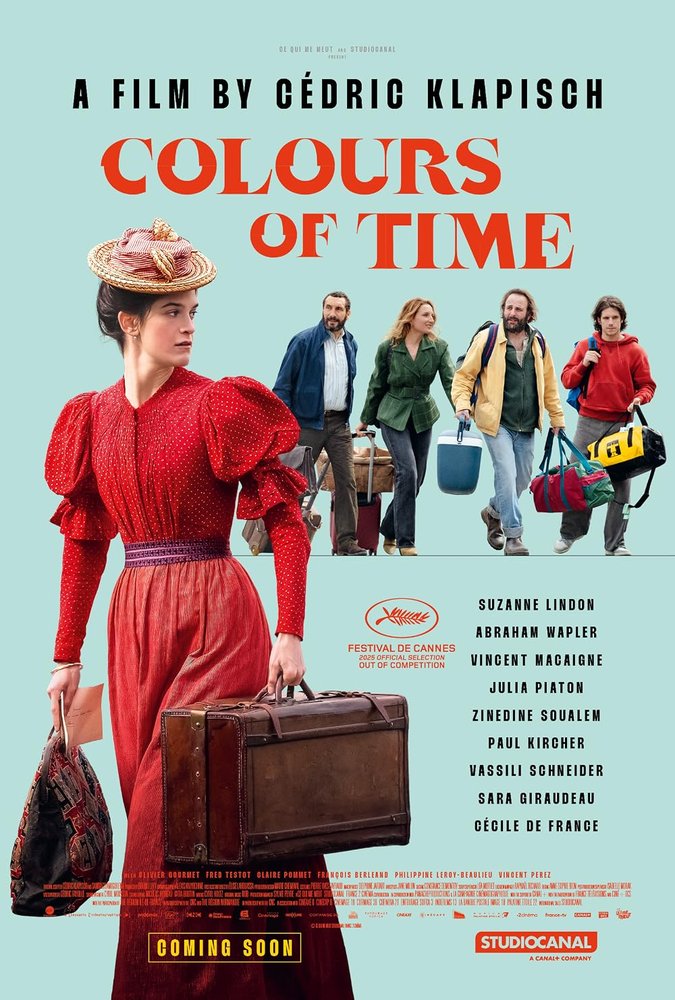
Colours of Time

Colours of Time (La Venue de l'avenir)

Movie · 2025 · 15 people

Cédric Klapisch made the 2025 period drama Colours of Time, titled La Venue de l'avenir ("The Arrival of the Future") in French, as a joint production of France and Belgium. Part family chronicle, part time-travel tale, it screened out of competition at the 78th Cannes Film Festival and opened in French cinemas on 22 May 2025, the same day, through StudioCanal.

The story alternates between two eras. Today, four cousins with very different lives inherit a house in rural Normandy and realise that their shared past has a mysterious side. The other strand reaches back to 1895, when the 21-year-old Adèle leaves her hometown for Paris to find her mother, in a city shaped by the rise of photography and the birth of Impressionism. As the cousins follow her trail step by step, they uncover her surprising life story.

Suzanne Lindon plays Adèle, Abraham Wapler plays Seb, Vincent Macaigne plays Guy and Julia Piaton plays Céline, with Zinedine Soualem, Paul Kircher, Cécile de France, Olivier Gourmet, François Berléand and Vincent Perez also in the cast. Klapisch wrote the script with Santiago Amigorena, and the producers include Ce Qui Me Meut. In Klapisch's own words, the film is about the importance of the past: we cannot move forward without looking back.

DirectorCédric Klapisch
Production companyCe Qui Me Meut

Reactions

You can pick up to 3 reactions.

Cast

François Berléand François Berléand Actor · 74 years old Vincent Perez Vincent Perez Film actor · 62 years old Suzanne Lindon Abraham Wapler Vincent Macaigne Julia Piaton Zineddin Sualim Paul Kircher Vassili Schneider Sara Giraudeau Cécile de France Philippine Leroy-Beaulieu Raïka Hazanavicius Pomme Olivier Gourmet

Through different eyes

Cinephile Looks at script, editing and directing choices; keeps a distance from formula films.

Klapisch, writing with Santiago Amigorena, works two timelines in parallel: four cousins today and Adèle in 1895. The strength of the structure is that it presents the past not as a backdrop but as a puzzle the present-day characters solve step by step. Still, the familiar trap of parallel narratives is here too, in my view: an 1895 Paris of rising photography and newborn Impressionism is so seductive, visually and dramatically, that the cousins' present-day story risks looking thin beside it. The dramatic-comedy tone lightens the load, but over 124 minutes, giving both worlds equal weight would have called for tighter editing.

History & Society Lens Asks about the period, the social background and what the work reflects.

There is a meaningful bridge between the two moments the film chooses. 1895 is when the rise of photography began to change images and, with them, family memory. Today, a family house left in the countryside reunites cousins leading very different lives around a shared past; inheritance here means memory more than property. A 21-year-old woman leaving her hometown for Paris to find her mother was no small step for women of the time, either. Klapisch's idea that we cannot move forward without looking back takes concrete form along this line running from country to city, from the individual to the family.

Family Viewer Asks whether the whole household can watch it; cares about humour and heart.

A warm family chronicle for anyone curious about where their family comes from. With its dramatic-comedy tone it is not a heavy drama. But the back-and-forth between two eras may be hard for young children to follow, and 124 minutes is long for them. Better for teenagers and adults; the kind of film that gets you talking about your own family's story afterwards.

These are not reader reviews: they are short editorial takes written from different viewer perspectives with AI assistance. Reader reviews are below.

Reviews (0)

Log in Log in to write a review.

Comments