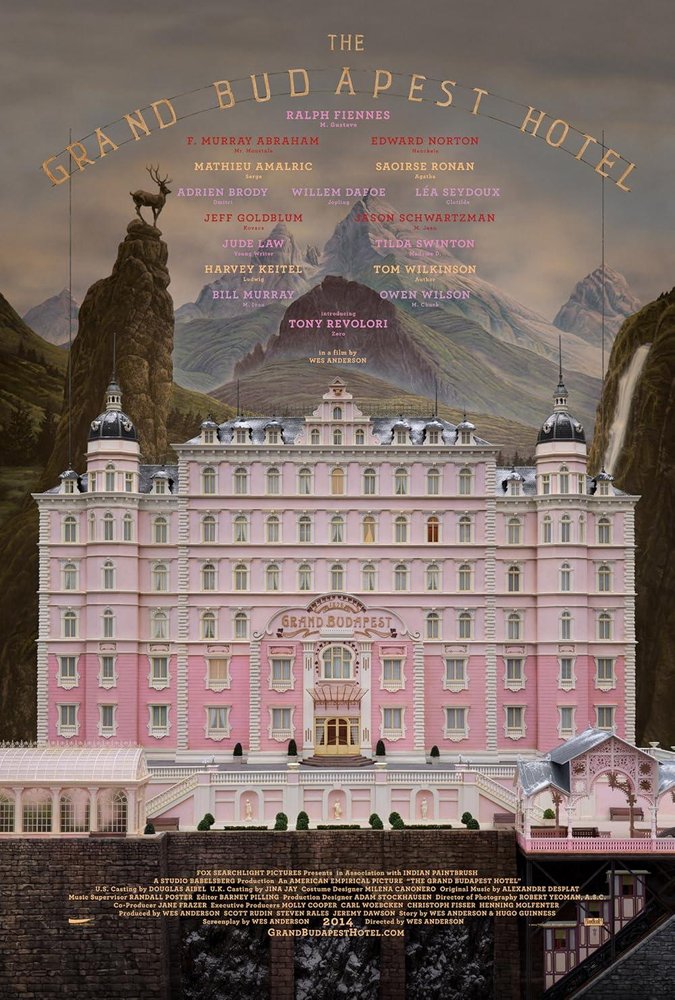
Büyük Budapeşte Oteli

The Grand Budapest Hotel

Movie · 2014 · 15 people

Wes Anderson wrote and directed The Grand Budapest Hotel, a 2014 comedy-drama and US-German co-production with Ralph Fiennes leading a seventeen-actor ensemble. It opened the 64th Berlin International Film Festival on February 6, 2014 and won the Silver Bear Grand Jury Prize. Released in March to widespread acclaim, it grossed $174.6 million, Anderson's biggest hit. It earned nine Oscar nominations and won four.

The story unfolds between the world wars in the fictional country of Zubrowka, at a mountainside hotel. Its renowned concierge, Monsieur Gustave H. (Ralph Fiennes), is framed for the murder of a wealthy dowager (Tilda Swinton). With his protégé and close friend, lobby boy Zero (Tony Revolori), he chases a priceless Renaissance painting and a fortune, while her heirs stop at nothing to get the painting back and a fascist regime closes in. Saoirse Ronan, Edward Norton, Jude Law and Bill Murray are also in the cast.

Anderson conceived the story with longtime collaborator Hugo Guinness, drawing on the writings of Austrian novelist Stefan Zweig. Filming took place in eastern Germany from January to March 2013. Alexandre Desplat composed the score. The film explores fascism, nostalgia, friendship and loyalty.

DirectorWes Anderson
Production companyAmerican Empirical Pictures

Reactions

You can pick up to 3 reactions.

Cast

Only cast members with a profile on this site are listed.

Tilda Swinton Tilda Swinton Actor · 65 years old Michaela Caspar Michaela Caspar Actor · 66 years old Ralph Fiennes Tony Revolori Saoirse Ronan Edward Norton Jude Law Owen Wilson Willem Dafoe Bill Murray Adrien Brody Jeff Goldblum Harvey Keitel F. Murray Abraham Tom Wilkinson

Through different eyes

Cinephile Looks at script, editing and directing choices; keeps a distance from formula films.

Wes Anderson's style reaches its most refined form here: meticulously arranged, postcard-like frames and Alexandre Desplat's playful score fall into a single rhythm. The murder accusation and the chase after a painting carry the adventure template with lively editing. But that flawless control also creates distance; at times the characters look like figures behind a shop window, and some of the emotional impact dissolves into the style. Still, turning four of its nine Oscar nominations into wins shows how solid the craft is. For Anderson fans it is a high point, and for those who find him detached it is, in my view, his most accessible film.

History & Society Lens Asks about the period, the social background and what the work reflects.

The film may be set in an imaginary country, but its background is entirely real: Europe between the two world wars and the rise of fascism. The inspiration from Stefan Zweig makes sense, because Gustave's world of refinement, courtesy and loyalty can be read as a symbol of a Europe that is slipping away. The hotel is a stage where different classes meet under one roof, and the friendship between the famous concierge and the young lobby boy Zero softens that hierarchy. Rather than depicting fascism head-on, the film sets it at the edge of a colourful fable; some may find that choice too light, but it uses nostalgia's power to remind us of what was lost.

Family Viewer Asks whether the whole household can watch it; cares about humour and heart.

It's colourful, fast and witty, and at first glance it looks fine for everyone. But the story runs on a mysterious death and a murder charge, with a fascist regime in the background. Some scenes and jokes may be too harsh or too hard to follow for young children. A fun adventure for teenagers and adults; if little ones are watching, take a look at it yourself first.

These are not reader reviews: they are short editorial takes written from different viewer perspectives with AI assistance. Reader reviews are below.

Reviews (0)

Log in Log in to write a review.

Comments