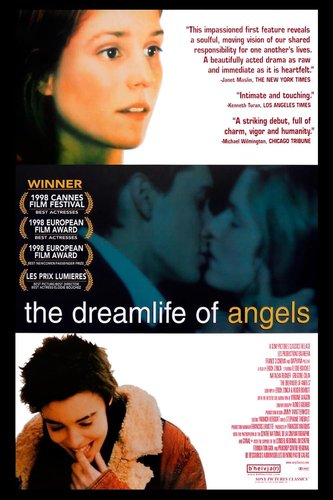
The Dreamlife of Angels (La Vie rêvée des anges)

The Dreamlife of Angels (La Vie rêvée des anges)

Movie · 1998 · 6 people

Érick Zonca made his 1998 French drama The Dreamlife of Angels (La Vie rêvée des anges) from a script he wrote with Roger Bohbot, for the producers Les Productions Bagheera and France 3 Cinéma. The film centers on the friendship of two young women in financial difficulty and was shown in the official competition at the 1998 Cannes Film Festival, where its two leads, Élodie Bouchez and Natacha Régnier, shared the Best Actress prize.

Isa (Élodie Bouchez) is an optimistic twenty-year-old who carries everything in a backpack and drifts from town to town on odd jobs. She befriends Marie (Natacha Régnier), whose temperament is her opposite, and the two move into an empty apartment whose owners were in a traffic accident; the family's only survivor, young Sandrine, lies in a coma. When Marie tries to build a lasting relationship with Chriss (Grégoire Colin), a nightclub owner, the friends begin to drift apart.

The film opened in France on September 16, 1998. At the 24th César ceremony in 1999 it won Best Film, Best Actress (Bouchez) and Most Promising Actress (Régnier). It also took the European Film Awards for Best Actress and European Discovery of the Year. France submitted it for the 71st Academy Awards, but it was not accepted as a nominee.

DirectorÉrick Zonca
Production companyLes Productions Bagheera

Reactions

You can pick up to 3 reactions.

Cast

Names without a link have no profile here yet.

Grégoire Colin Grégoire Colin Film actor · 51 years old Chriss Élodie Bouchez Natacha Régnier Corinne Masiero Jo Prestia Patrick Mercado

Through different eyes

AI-assisted editorial takes written from different viewer perspectives. They are not reader reviews; those are below.

Cinephile Looks at script, editing and directing choices; keeps a distance from formula films.

The film is a character study pitting two opposite temperaments against each other, and its full weight rests on the two leads. That they shared the prize at Cannes, and were each honored separately at the Césars, shows the balance holds; in structures like this, pushing one forward and the other into the background is a common mistake. Zonca's approach leans on the texture of the relationship rather than on plot, and the César for Best Film plus European Discovery of the Year at the European Film Awards suggest the direction deserves its share of credit. My reservation: the optimist-versus-pessimist contrast is a little too tidy, and the two women at times risk standing in for theses. What the unshowy storytelling really yields is two lead performances that balance each other.

History & Society Lens Asks about the period, the social background and what the work reflects.

The film looks at young women living precarious lives in late-1990s France. Isa, who carries everything she owns in a backpack and drifts from town to town on odd jobs, reads like a portrait of a generation without steady work or a home. That the two friends can only settle in a flat belonging to others, a family lying in a coma, makes the housing problem strikingly concrete. Marie's effort to build a lasting relationship with a nightclub owner points to the fragility of looking for a way out of poverty through an emotional bond. For anyone interested in European social realism, an honest record of its time.

Family Viewer Asks whether the whole household can watch it; cares about humor and heart.

It follows two young women in financial hardship, their loneliness, their friendship and their relationship troubles; the subject is heavy, and it does not suit a family sit-down. It is not for children and will not hold much appeal for younger teens either. Adults, especially those who enjoy quiet, emotional dramas, will get more out of it watching on their own.

Reviews (0)

Log in Log in to write a review.

Comments