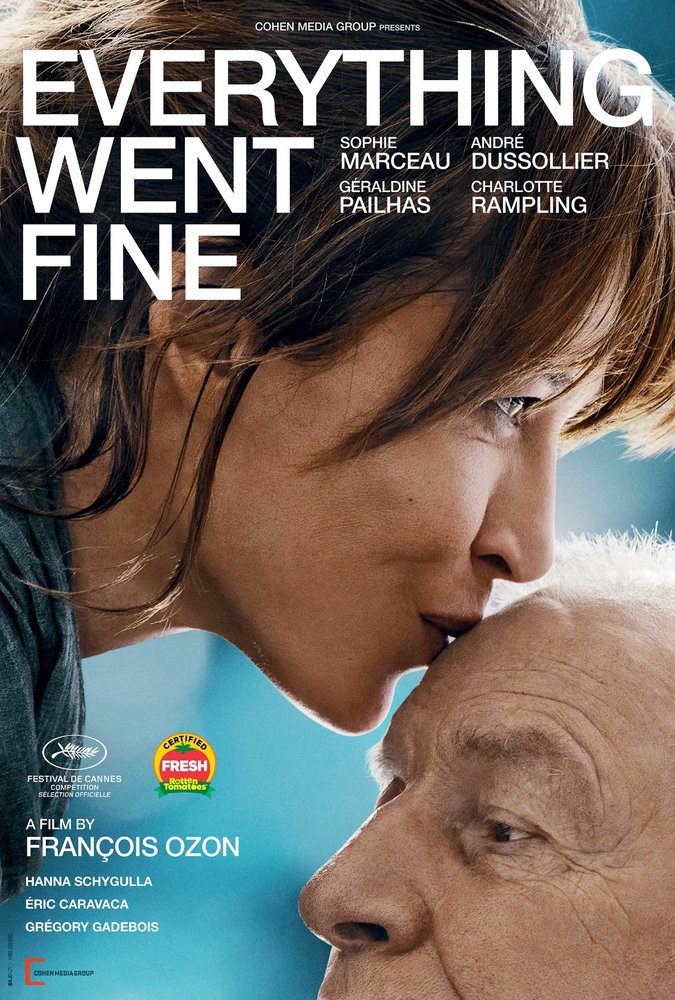
Everything Went Fine

Everything Went Fine (Tout s'est bien passé)

Movie · 2021 · 8 people

François Ozon wrote and directed Everything Went Fine, known in French as Tout s'est bien passé, a French comedy-drama from 2021. Based on Emmanuèle Bernheim's autobiographical memoir Everything Went Well, it deals with assisted dying and moves between drama and comedy. It had its world premiere in the main competition of the 74th Cannes Film Festival on 7 July 2021 and opened in France on 22 September 2021 through Diaphana Distribution. It reached German cinemas on 14 April 2022 and Turkish ones, as Her Şey Yolunda, on 24 December 2021. Critics rated it highly.

Sophie Marceau plays Emmanuelle, a writer whose private and professional life is going well. When she learns that her father André (André Dussollier) has had a stroke at 85, she rushes to his side. An unconventional man unwilling to go on living this way, André asks her from his hospital bed to help him end his life. Emmanuelle is torn between granting his wish and trying to change his mind. The cast includes Géraldine Pailhas, Charlotte Rampling, Hanna Schygulla, Éric Caravaca and Grégory Gadebois.

Alain Cavalier had earlier been meant to film the material. The film mixes French, English and German and runs about 113 minutes.

DirectorFrançois Ozon

Reactions

You can pick up to 3 reactions.

Cast

Only cast members with a profile on this site are listed.

Sophie Marceau Sophie Marceau Actor · 59 years old Hanna Schygulla Hanna Schygulla Actor · 82 years old André Dussollier Géraldine Pailhas Charlotte Rampling Éric Caravaca Grégory Gadebois Jacques Nolot

Through different eyes

Cinephile Looks at script, editing and directing choices; keeps a distance from formula films.

Ozon's most striking choice is to treat a subject as heavy as assisted dying in a tone that moves between drama and comedy. It seems chosen not to shrink the subject but to reflect the father's unconventional personality, so a film about death also becomes a portrait of a stubborn, colourful father. Its roots in an autobiographical memoir add authenticity. The weak point is that the same balance of tone sometimes dissolves the moral and legal complexity of the subject into lightness; the daughter's dilemma does not always reach the depth it deserves. Still, it is one of the director's mature, assured works.

History & Society Lens Asks about the period, the social background and what the work reflects.

The film takes up assisted dying, still legally and morally contested in many countries, not as an abstract debate but through a concrete relationship between a father and his daughter. Questions of old age, independence and the right to decide one's own end collide here with a sense of family duty. Emmanuelle, torn between granting her father's wish and talking him out of it, is an extreme case of dilemmas many families with ageing parents will recognise. Rather than imposing a ready answer, the film puts the question in front of the viewer, which makes it valuable as a conversation starter.

Family Viewer Asks whether the whole household can watch it; cares about humour and heart.

The subject is heavy: an elderly father who has had a stroke asks his daughter to help him end his life. There are funny moments along the way, but this is not one to watch with children. For adults with an elderly mother or father, it can prompt real thought and conversation. It is also fair to say it may be hard going for anyone who has recently been through illness or loss.

These are not reader reviews: they are short editorial takes written from different viewer perspectives with AI assistance. Reader reviews are below.

Reviews (0)

Log in Log in to write a review.

Comments