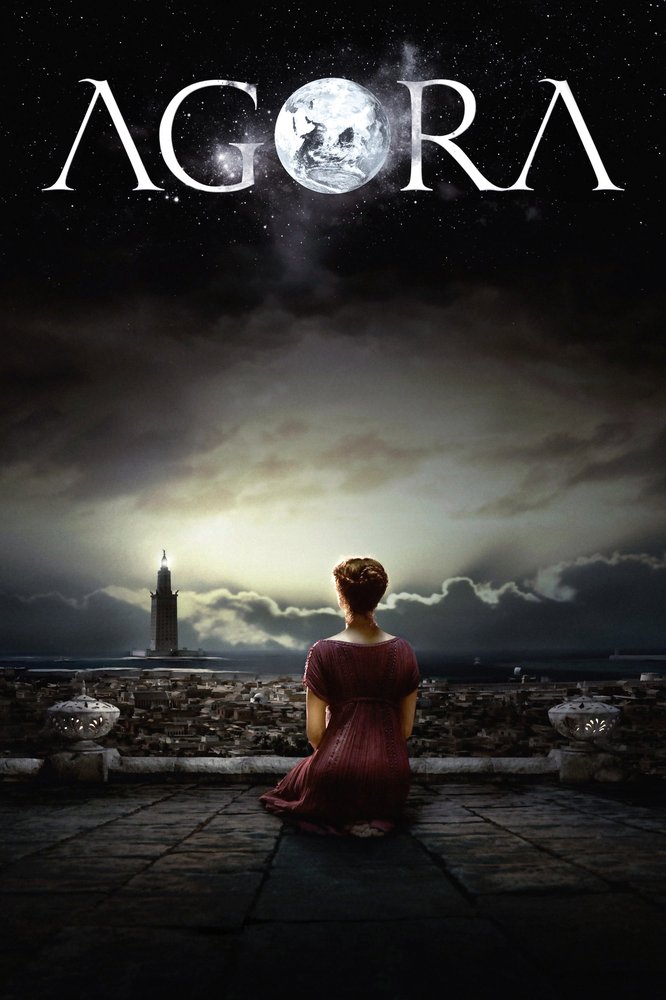
Agora

Agora

Movie · 2009 · 15 people

Alejandro Amenábar directed Agora (Ágora), a Spanish-produced, English-language historical drama from 2009, and wrote it with Mateo Gil. A biopic told through historical fiction, it is set in Roman-ruled Alexandria from 391 AD and examines religion and science as polytheism declines and the Empire turns Christian. The title comes from the agora, the public gathering place of ancient Greek cities. It opened in Spain on October 9, 2009 and became that country's highest-grossing film of the year.

Rachel Weisz plays Hypatia, a late fourth-century mathematician, philosopher and astronomer who probes the flaws of the geocentric model and the heliocentric one that challenges it. As tension among pagans, Jews and the rising Christians turns violent around her, she tries to save the learning of classical antiquity from destruction. Max Minghella plays Davus, her father's slave, and Oscar Isaac her student Orestes, later the city's prefect. Michael Lonsdale and Ashraf Barhom are also in the cast.

Fernando Bovaira produced the film, shot in Malta from March to June 2008, with Justin Pollard as historical adviser. It screened out of competition at Cannes in 2009. In Spain it won seven Goya Awards, including Best Original Screenplay, and it took the Sloan Foundation prize at the Hamptons festival. It was criticised for historical inaccuracies.

DirectorAlejandro Amenábar
Production companyTelecinco Cinema

Reactions

You can pick up to 3 reactions.

Cast

Only cast members with a profile on this site are listed.

Michael Lonsdale Michael Lonsdale Actor · died at 89 Ashraf Barhom Ashraf Barhom Actor · 47 years old Rachel Weisz Max Minghella Oscar Isaac Rupert Evans Hümayun Erşadi Manuel Cauchi Richard Durden Sami Samir Yousef Sweid George Harris Amber Rose Revah Jordan Kiziuk Sylvester Morand

Through different eyes

History & Society Lens Asks about the period, the social background and what the work reflects.

Agora's greatest strength and its most debatable feature are the same thing: it stages a complex transformation that took centuries, the Christianisation of the Roman Empire, as a sharp opposition between science and bigotry in Alexandria. So it is no surprise it was criticised for historical inaccuracies. Even so, in asking how fragile knowledge is in a city where tension between communities turns violent, the film poses a question that speaks to today. In my view it is best watched not as a history lesson but as an interpretation written from a particular standpoint. Putting Hypatia at the centre is valuable in itself, because it makes visible a woman doing science in antiquity.

Cinephile Looks at script, editing and directing choices; keeps a distance from formula films.

Amenábar's choice is bold: building a large-scale historical production around astronomy rather than battlefields. Turning a thinker wrestling with the flaws of the geocentric system into an object of cinematic curiosity is not easy, and the film tries to balance that intellectual quest with the violence rising in the city. The ancient Alexandria built in Malta offers an impressive sense of scale. In my view, though, the script uses characters like Davus and Orestes as carriers of ideas, so it turns schematic at times; people become spokesmen for an argument. Seven Goya Awards, including Best Original Screenplay, show the ambition found its audience in Spain, yet the balance between emotional intensity and thesis-driven storytelling does not always hold.

Family Viewer Asks whether the whole household can watch it; cares about humour and heart.

It is a film that values science and curiosity, and watched with teenagers it can start a good conversation afterwards. But be warned: the tension between communities turns violent, and religion is handled in a heavy way. It is not suitable for young children, and older relatives who are sensitive about faith may find some parts upsetting. In my view it is best watched with teenagers, after talking the subject through first.

These are not reader reviews: they are short editorial takes written from different viewer perspectives with AI assistance. Reader reviews are below.

Reviews (0)

Log in Log in to write a review.

Comments